
Here is the complete English translation of the provided article, organized clearly by section headings for easy reading.
MEMS Sensors Accelerate Toward Combo Designs
With the evolution of manufacturing technologies for MEMS accelerometers and electronic compasses, integrated "Combo" designs combining multi-axis sensors with control ASICs are expected to materialize quickly and gradually become the mainstream of the market.
Smartphone and tablet manufacturers are actively seeking intelligent sensing solutions. This is driving demand for various Micro-Electromechanical Systems (MEMS) motion sensors, including 3-axis accelerometers, 3-axis electronic compasses (magnetic sensors), 3-axis gyroscopes, and single-axis pressure sensors. The industry collectively refers to these as 10-axis motion sensors.
The aforementioned sensors each have dominant international manufacturers providing appropriate solutions for smartphone factories. At the same time, the penetration rate of each sensor type in mobile devices varies. The penetration rate of accelerometers is nearly 100%, electronic compasses are at about 20–30%, and gyroscopes sit around 10–15%. As for pressure sensors, they are currently only equipped in a small number of flagship models from select brands.
Competition in MEMS Sensor Technology Intensifies Daily
As the demand for MEMS sensors expands, market competition is also becoming increasingly fierce. Major international sensor chip makers—including STMicroelectronics (ST), Bosch Sensortec, AKM (Asahi Kasei Microdevices), and InvenSense—as well as newcomers like mCube, are competing at full strength to seize market opportunities. Below is a step-by-step analysis of each manufacturer's product layout.
Rushing for Market Share: Bosch Sensortec Aggressively Pushes 6-Axis Solutions
Bosch Sensortec currently holds the majority of the market share for accelerometers. Its related products mostly utilize an LGA Package 2 mm x 2 mm x 1.95 mm. It can provide solutions at different price points tailored to customer specification requirements (such as digital resolution, sensitivity, and current consumption).
Bosch Sensortec was also the first to release the world's smallest accelerometer, measuring 1.2 mm x 1.2 mm x 0.8 mm, utilizing a Wafer-Level Chip-Scale Package (WLCSP). It intends to use packaging and technical specifications to block other international manufacturers from entering the customer supply chain via a pin-to-pin compatible approach. However, whether smartphone factories are willing to adopt a solution that is not pin-compatible remains to be seen.
To capture the electronic compass market, Bosch Sensortec has not only launched a 3-axis electronic compass but has also stepped up development on a 6-axis product that integrates both the electronic compass and the accelerometer. This aims to continuously increase its market share in the electronic compass sector.
However, the current price of discrete solutions (where the electronic compass and accelerometer are kept separate) is still cheaper than a single-chip integrated 6-axis sensor. Consequently, the acceptance of discrete solutions remains relatively high in the low-to-mid-range smartphone market. In the future, if the price of a single-chip 6-axis product drops to a level comparable to discrete solutions, multi-functional integrated (Combo) designs will inevitably become the trend.
Betting on Sensor Hub Solutions: ST Focuses on the High-End Phone Market
STMicroelectronics (ST) and Bosch Sensortec are among the few international MEMS giants that possess a complete line of 10-axis sensors. Unlike its competitors, ST offers an integrated 6-axis solution (accelerometer plus gyroscope). Because gyroscope prices remain high and application scenarios are relatively limited, these are currently only featured in high-end models, resulting in a market penetration rate that is not yet high.
To expand its high-end market presence, ST is further adopting the Cortex-M0 core to develop a Sensor Hub. By integrating this with 6-axis sensors, it can assist the system processor in reducing power consumption and executing sensor fusion algorithms, making system operations more efficient. However, a sensor hub increases the cost of adding a microcontroller (MCU) and increases the required number of surrounding passive components and printed circuit board (PCB) space. How to strike a balance between cost and efficiency depends on the strategies of smartphone manufacturers.
Competing for the Electronic Compass Market: Global and Local MEMS Factories Battle It Out
AKM has long held a very high market share in the electronic compass market, roughly 70–80%. This is mainly because AKM uses Hall Effect technology, which features a relatively simple manufacturing process, offering advantages in yield and cost. Furthermore, current applications are limited to sensing the Earth's magnetic direction, which does not require extremely high accuracy (allowing for a ±7º error margin). However, if Augmented Reality (AR) applications become widespread in the future—requiring higher directional accuracy (within a ±1º error margin)—it may not necessarily maintain such a high market share.
To maintain its high market share, AKM is continuously rolling out small-sized packaged products. However, ALPS has recently also adopted WLCSP packaging to create what it claims to be the world's smallest electronic compass, measuring just 1.15 mm x 1.15 mm x 0.56 mm. This is expected to trigger ongoing competition over size specifications in the market.
Volterra (iST) / Alternative local context: Isentek is one of the few companies in Taiwan with a proven track record in the mass production of MEMS sensing components. Currently, it primarily promotes electronic compasses based on the Anisotropic Magnetoresistive (AMR) sensing principle, which offers higher accuracy compared to Hall Effect solutions. At a 10 Hz sampling rate, this solution consumes only about 89\muA of power—roughly one-half to one-third the level of other solutions on the market. Additionally, its anti-magnetic interference design utilizes hardware de-gaussing circuitry, freeing users from having to perform "figure-8" hand gestures for calibration, making it more convenient for consumers to use.
Below, we will separately analyze the technological development of accelerometers and electronic compasses, the two sensors with higher market penetration rates.
Component Characteristics Vary Greatly: Capacitive and Piezoresistive Accelerometers Excel in Their Own Ways
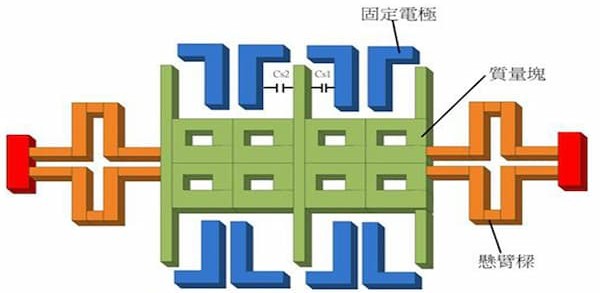
Figure 1: Schematic Diagram of a Capacitive Accelerometer Structure
On the Earth's surface, the falling acceleration of an object is defined as 1g (Gravity), where 1g = 9.81m/s2. Acceleration is typically expressed in units of g. It is mainly composed of separate electrical circuitry and mechanical MEMS structures. The most common types on the market today are capacitive and piezoresistive accelerometers. Most packaging connects the Application-Specific Integrated Circuit (ASIC) and the accelerometer via wire bonding, utilizing a stacked method to reduce chip area.
The following is a brief introduction to the characteristics of capacitive and piezoresistive accelerometers:
Piezoresistive Accelerometers
Structure: Simple. It utilizes a combination of a Proof Mass and a Cantilever Beam.
Principle: It utilizes pressure changes generated by inertial forces during acceleration to alter resistance values. When acceleration acts on the component, the proof mass shifts due to inertia, causing the cantilever beam to deform. This changes the piezoresistive value on the beam. By utilizing a circuit typically designed as an equivalent Wheatstone Bridge, the voltage difference across both ends is measured. This is amplified and processed by an Analog-to-Digital Converter (ADC) to detect changes in the device's acceleration.
Pros & Cons: If a piezoresistive design aims to save power, it must increase resistance values, which inherently increases noise. Furthermore, piezoresistive values shift easily with temperature changes, affecting sensitivity and zero-point drift (Offset). Therefore, temperature compensation measures must be integrated, which are critical focus points during design.
Output & Suppliers: In terms of sensitivity, a piezoresistive type yields roughly several hundred microvolts (uV) to tens of millivolts (mV) per 1g of change. Main suppliers are predominantly Japanese manufacturers.
Capacitive Accelerometers (Figure 1)
Principle: It primarily determines acceleration by measuring changes in variable capacitance. The variable capacitor consists of two plates: one is a fixed electrode, and the other is the proof mass, which shifts due to inertia when subjected to acceleration. This shifts the distance between the electrodes.
Mechanism: As the distance between the plates changes, the capacitance values (Cs1, Cs2) change accordingly. This value is converted into a voltage signal via a Capacitance-to-Voltage Converter (C-V Converter), amplified, and handed over to the ADC for processing.
Pros & Cons: Capacitive accelerometers consume very little power and exhibit minimal temperature effects. However, because the distance between the capacitive electrodes is very narrow, improper design can cause the electrodes to stick and fail to return, or dust particles can fall between the plates and cause failure. Consequently, cleanroom requirements during manufacturing are exceptionally high.
Output & Suppliers: The capacitance change is roughly a few femtofarads (fF) to tens of fF of change. Main suppliers are predominantly European and American manufacturers.
Market Summary
The current mainstream market is still dominated by capacitive types. Although capacitive accelerometers offer better performance, they require higher manufacturing process technologies. On the other hand, while piezoresistive types consume slightly more power and have higher noise, their manufacturing process is relatively simple. Given the fierce price competition for accelerometers in the current market, there is a shifting trend toward adopting piezoresistive accelerometers.
When applying accelerometers to the wearable device market, both capacitive and piezoresistive types face the challenge of integration. Because only through full integration can ultra-small form factor requirements be met, the integration of the accelerometer and the control chip will be the key technology determining who dominates the future market.
Meeting AR/LBS Development: Electronic Compasses Improve Sensitivity and Accuracy
Because navigation has become a fundamental feature and future development direction for consumer electronics, the demand for electronic compasses is set to rise significantly. Application software derived from movement and orientation sensing capabilities will increasingly combine with cloud computing technologies to drive the development of Augmented Reality (AR) and Location-Based Services (LBS).
For basic navigation needs, the required accuracy of an electronic compass allows for an error margin within ±7º. However, for AR or LBS applications that rely on identifying distant target objects, the error margin must be strictly under ±1º. Therefore, the future development trend for electronic compasses—in addition to optimizing commercial designs—will heavily focus on improving sensitivity and accuracy.